Entry 001
PleoStack Construction Hub Is Live


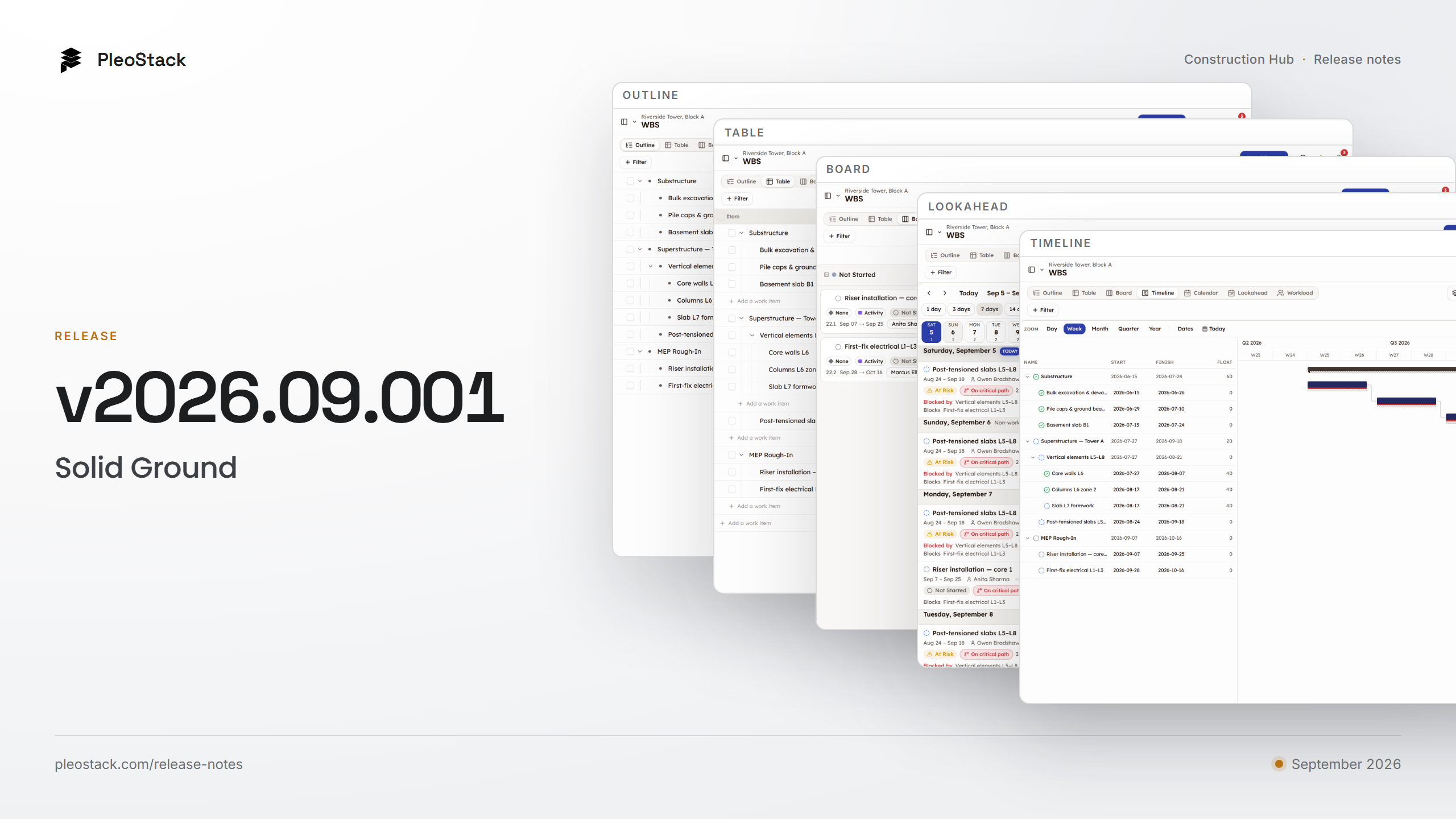
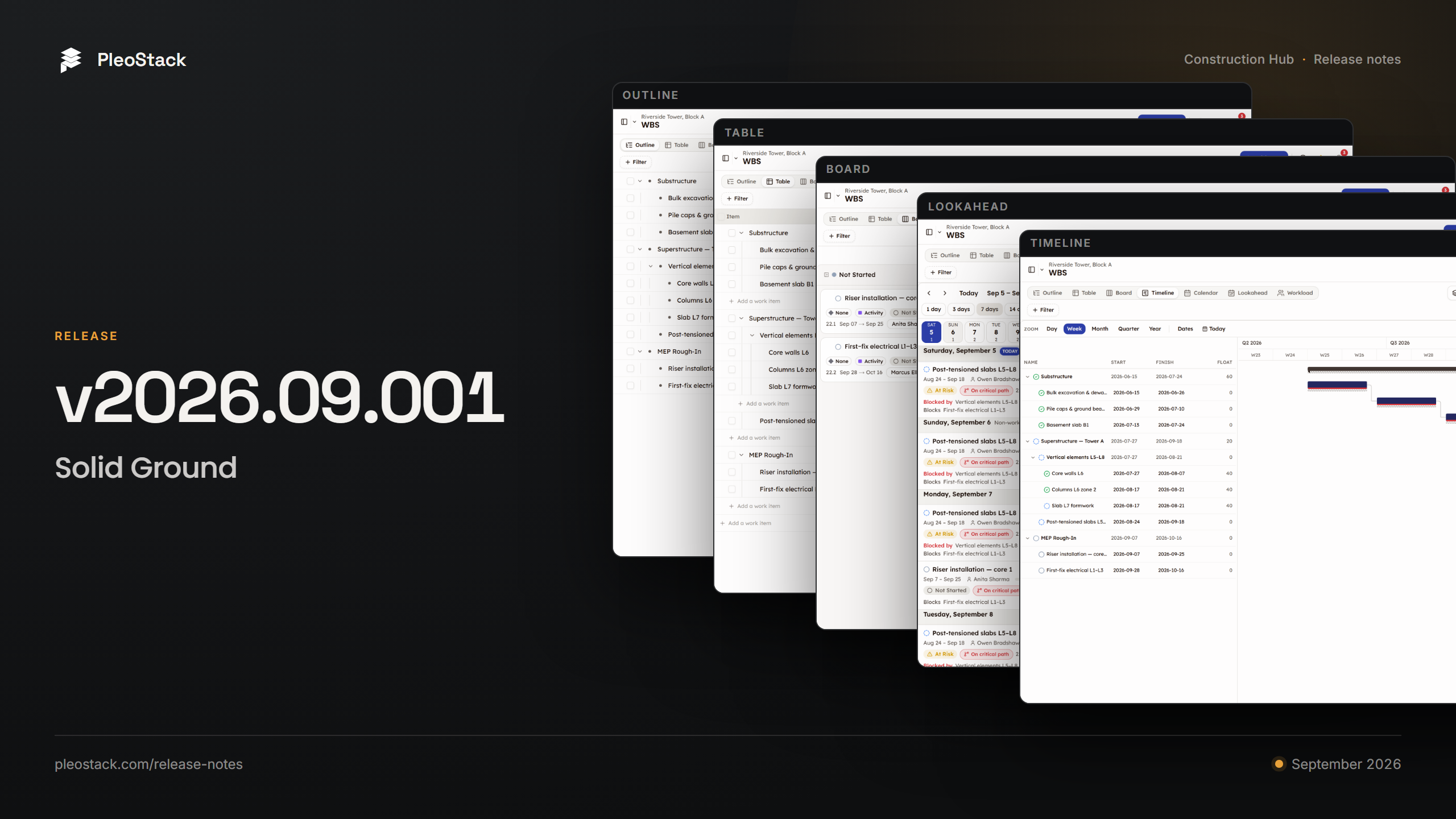
The Construction Hub is now available — one place for inspections, safety, resources, documents, and the rest of the work that used to live in spreadsheets and WhatsApp. Here is what shipped, starting with the modules teams have leaned on hardest.

Praful Rudra · Co-Founder & CEO
Updated 4 min read
Today the PleoStack Construction Hub is live. It is the first vertical in the platform we set out to build — software shaped to how construction actually runs, not a generic tool bent to fit. If you want the longer story behind that decision, it is in why we built PleoStack. This post is about what you can use right now.
We built the Hub around the parts of a project that hurt most when they live in spreadsheets and chat threads. Two of those came first, because they are where teams told us the pain was sharpest: inspections and safety.
Inspections that hold up as a record
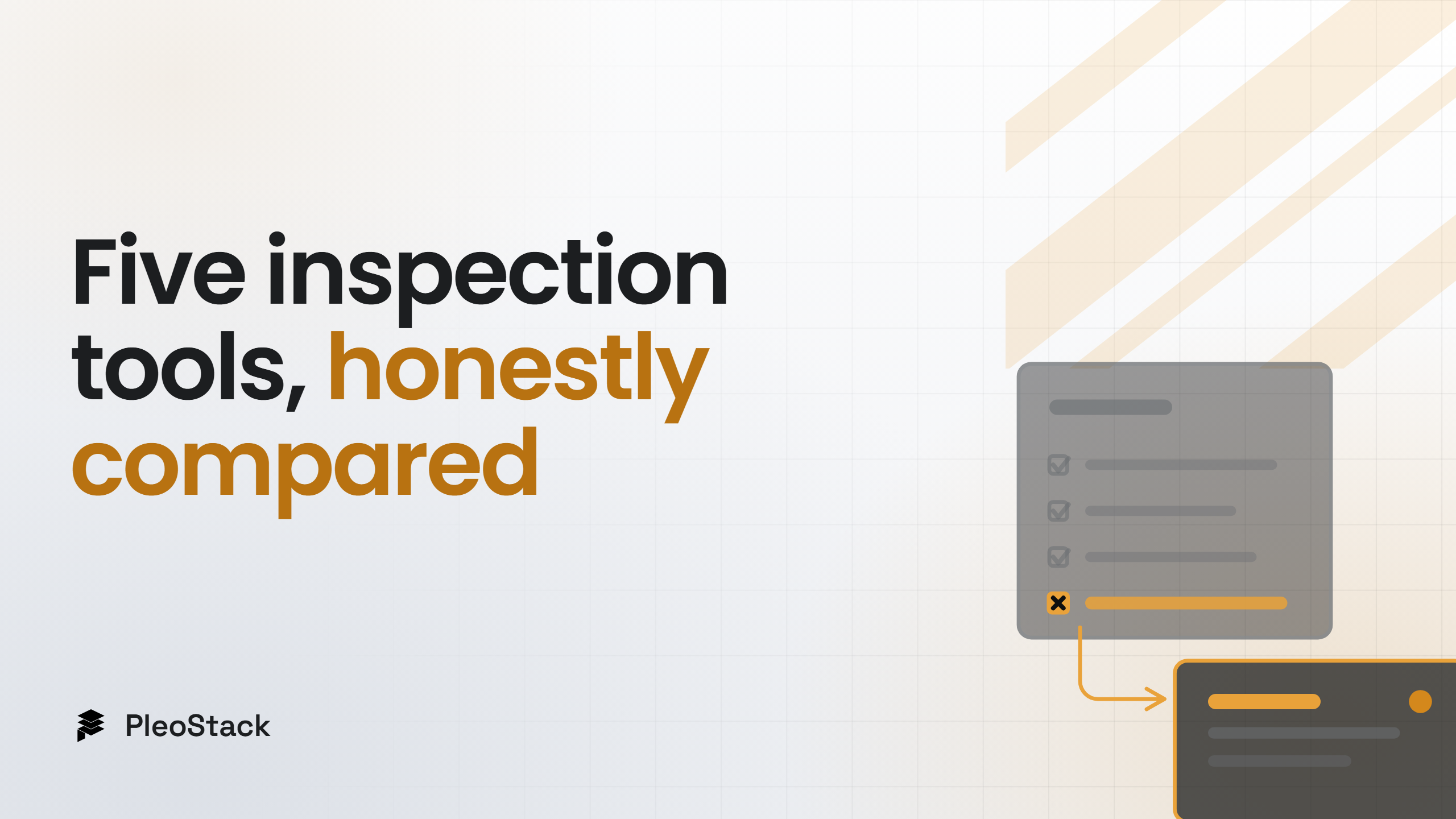
Quality inspections are only worth doing if the record survives — if, months later, you can prove what was checked, by whom, and what happened next. On paper and in photo galleries, that record decays. In the Hub, an inspection is structured from the start.
- Customizable checklist templates so each discipline inspects the right things
- A multi-party, sequential workflow — the work is checked, then verified, in order, on the record
- Evidence captured against each item, not lost in a chat gallery
- Failed items that automatically become tracked quality issues, so nothing quietly disappears
The point is not digitizing a form. It is that the inspection, its evidence, and the follow-up all stay connected. See how it works on the Inspections page.
Safety in one console
Safety is the other place where scattered records are not just inefficient — they are a liability. The Hub brings the whole safety picture into one place instead of spreading it across a talks logbook, an incident file, and a permit binder. The Safety module is in beta — live and in active use ahead of its first versioned release.
The Safety module covers the workflows a site runs every day:
| Workflow | What it does |
|---|---|
| Toolbox talks | Record talks and attendance against the crew |
| Safety walks | Log observations with photos from a phone browser |
| Permits to work | Issue and control permits with a clear approval trail |
| Incidents | Capture, manage, and close incidents with the record intact |
Permits to work are worth calling out, because they carry the most process. A permit is not a single form — it is a checklist that must be completed, documents that must be attached, and a sign-off that has to happen in the right order before any work starts.
Everything the permit depends on lives in one place: the pre-activation checks, the licenses and method statements it requires, and the ball-in-court sign-off between requester and approver. Nothing gets waved through because a step was invisible. More on the Safety and Permits pages.
Resources and documents, under control
Behind inspections and safety, two more modules keep the project honest.
Resources brings inventory, deliveries, and vendor tracking into one register — so what was ordered, what arrived, and who supplied it stops living in someone's memory and a stack of delivery notes.
Documents gives every project one shared file library — a folder tree the whole team navigates the same way, with drag-and-drop upload for drawings, permits, method statements and the rest of the site paperwork. One agreed structure per project, instead of one per person.
Explore Resources and Documents for the detail.
And the rest of the Hub
Inspections, safety, resources, and documents are where we would start most teams. But the Hub is a complete system, and the rest is live today too:
- WBS — hierarchical work planning and tracking, from program down to task
- Issues — defect and deficiency tracking across quality, safety, and punch list, from discovery to closure
- Reports — structured daily logs, analytics, and client report delivery
- RFIs (beta) — numbered, routed requests for information with an official answer on the record
- Material submittals — a catalog and approval workflow for materials
- Dashboard — customizable project metrics and charts
One place for the work, instead of five tools and a group chat.
Where we are
We have shown the Hub to a good number of project managers, and the response has been what kept us building: it looks like the way they already work, minus the spreadsheet tax. We also have early pilot interest from construction teams putting it against real projects — which is exactly the test that matters.
If you run construction projects and any of the above sounds like a weekend you would like back, book a demo. Tell us where your current stack breaks, and we will show you the part of the Hub built for exactly that.
For the full running list of what ships next, follow the Construction Hub release notes.